How to Protect Your Money From Inflation — A Practical Playbook
Inflation quietly reduces your purchasing power each year. This page gives a simple, actionable playbook middle‑class earners can use to stop falling behind: triage cash, build anti‑inflation income, use leverage wisely, and shift from selling time to owning assets that grow with or beat inflation.
- Why your first goal is to avoid falling behind
- The 3 layers of cash: emergency, opportunity, dead cash
- How to create anti‑inflation income
- Good debt vs bad debt
- Order of asset accumulation & the earner→owner mindset
1 — Your first goal is NOT to get rich — it’s to avoid falling behind
Many people wait to invest because they “don’t have enough.” The reality: if your money doesn’t grow faster than inflation, you are losing purchasing power each year. Keeping cash long‑term equals slow, guaranteed loss. Your immediate priority is preserving real purchasing power, not chasing fast gains.
2 — Rebuild how you think about money: Cash ≠ Savings
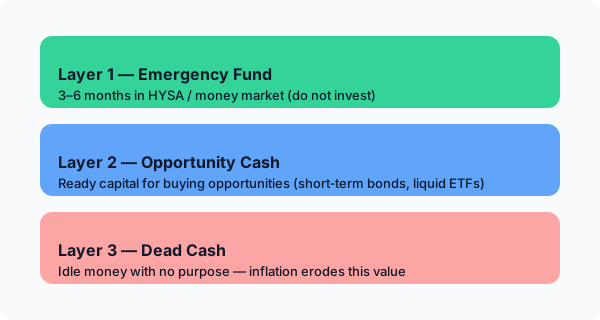
Divide cash into three purpose-driven layers so every dollar has a job.
Layer 1 — Emergency Fund (3–6 months)
Purpose: liquidity for job loss, medical expenses, or large repairs. Keep this in a high‑yield savings account or money market. This is psychological insurance — don't invest it.
Layer 2 — Opportunity Cash
Purpose: capital ready to buy assets when opportunities appear. Accept small fluctuations — this money should be accessible and positioned to convert to equity or real estate quickly.
Layer 3 — Dead Cash (eliminate)
Definition: cash sitting idle with no purpose for years. Inflation is eroding it. Reassign dead cash into Layer 1/2 or into investments that at least keep pace with CPI.
3 — Turn your income into “anti‑inflation income”
Ask: if inflation is 5% this year, does my income rise automatically? If not, your income is being eroded. Prioritize income sources that naturally grow or can be increased:
- Equities — index ETFs and broad stock ownership are the most reliable long‑term hedge.
- Rental real estate — rents often track inflation over time.
- Side businesses with pricing power — ability to raise prices preserves margins.
4 — Don’t fear debt — fear bad debt
Not all debt is equal. Eliminate high‑interest consumer debt first (credit cards, payday loans). Low, fixed‑rate mortgage debt used to buy cash‑flowing assets is often "good debt" — inflation reduces its real cost over time.
5 — Prioritize ownership before upgrading your lifestyle
When income increases, allocate new dollars to ownership (investments, down payments, business) before upgrading recurring spending. Ownership compounds; lifestyle inflation compounds costs.
Part II — The Mindset Shift: Earner → Owner
6 — Understand what you are actually selling
Most middle‑class earners sell time; time is limited. Owners buy systems and assets that generate income beyond working hours. You don’t need to quit your job — you need to buy assets that earn while you sleep.
7 — Don’t ask “What should I invest in?” — ask “What do I own?”
Focus on building ownership in broad equity exposure, income rights, and assets that rise with inflation. If you own nothing, inflation and wage stagnation will erode your position.
8 — Accumulate assets in the right order
A practical order for most households:
- Emergency fund
- Index ETFs / retirement accounts
- Real estate (when qualified)
- Business / private equity (when ready)
9 — Use leverage only after you’ve proven you can survive
Only introduce leverage when income is stable, buffers exist, and you have a disciplined plan. Leverage amplifies both gains and losses; survive first, then scale.
10 — Final mindset
Inflation is a persistent test. Those who hold cash or only earn wages are the most vulnerable. You don’t need to beat the system — you need to stand on the right side of it by owning assets.
Turn this mindset into a plan
Portfolio Optimizer helps you translate the anti‑inflation framework into action: check your emergency fund, see your cash vs equity split, and get a tailored plan to start owning equities and income‑producing assets.
Start your Anti‑Inflation PlanNext steps (quick checklist)
- Set an emergency fund: 3–6 months in HYSA
- Automate investments into low‑cost index ETFs
- Keep opportunity cash ready for buying opportunities
- Avoid high‑interest consumer debt; use mortgage debt only for assets
- Reassess every 6 months and prioritize ownership with new income
🔔 Ad Space